

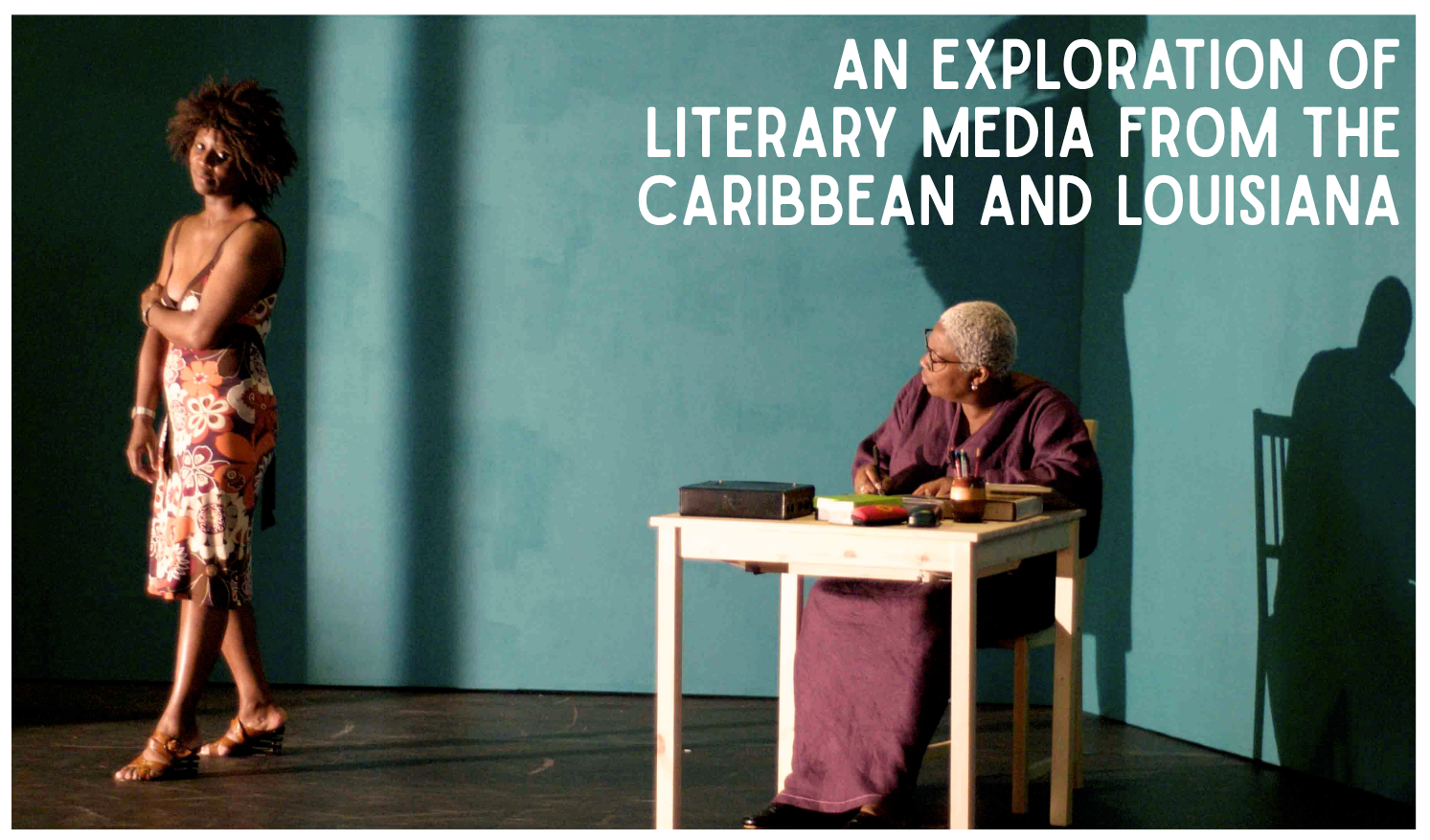
Literature class schedule: Sept. 23, Oct. 7, Oct. 21, Nov. 4, Nov. 18, Dec. 9.
A full breakdown of the works is below. Register now before the class fills up!
This course focuses on female writers/poets from the Caribbean or Louisiana who write in French or Creole and who have played an important role in Caribbean literature. It is a continuation of the spring 2026 semester course, but new students are absolutely welcome since we are always discussing new texts. In French or Creole (with translation). Some classes will use documentary, archive, and film to reinforce these points of discussion.
September 23rd
Film: La Ballade de Suzanne Césaire (Criterion Channel)
Directed by Madeleine Hunt-Ehrlich • 2024 • USA
Starring: Zita Hanrot, Motell Gyn Foster, Josué Gutierrez
A sumptuous, spellbinding anti-biopic as provocative and elusive as its subject, this hypnotic journey through the world of Caribbean surrealist writer and anti-colonial activist Suzanne Césaire daringly deconstructs the process of bringing an actually lived life to film. In the sleepy palm groves of the tropics, a small group of filmmakers—including an actor and new mother (Zita Hanrot) haunted by voices as she embarks on inhabiting the title role—stage scenes from the enigmatic intellectual’s life, exploring her youth in Martinique, literary legacy, and relationship with her husband, the writer and politician Aimé Césaire. Inspired by the structures of Suzanne Césaire’s own writing, which often took a colonial convention and unraveled it, THE BALLAD OF SUZANNE CÉSAIRE plants us firmly in the darkness and desire of its subject while acknowledging the impossibility of resuscitating a legacy partially lost to time. Suzanne Césaire was a French writer, teacher, scholar, anti-colonial and feminist activist, and surrealist. She co-founded the Martinique cultural journal Tropiques, of which she was also an editor, along with her husband, Aimé Césaire, and René Ménil, both of whom were notable French poets from Martinique.
Madeleine Hunt-Ehrlich (born 1987) is an American visual artist, filmmaker, and educator, based in Brooklyn, New York. Hunt-Ehrlich's work often explores the Black women's experience, Afro-Surrealism, and Pan-Africanism. She is an assistant professor in the Media Studies department at the Queens College, City University of New York.
October 7th
Malaise d'une civilisation (1942) by Suzanne Césaire
Malaise d'une civilisation is a critical essay written by Suzanne Césaire and published in April 1942 in the fifth issue of the Martinican literary and cultural review Tropiques. The text examines the spiritual and cultural crisis of colonial Martinique under the Vichy regime, critiquing European bourgeois values and calling for an authentic Caribbean awakening rooted in the island's unique multi-ethnic reality.
October 21st
Tales from the Heart: True Stories from My Childhood (1999) by Maryse Condé
In this collection of autobiographical essays, Maryse Condé vividly evokes the relationships and events that gave her childhood meaning: discovering her parents’ feelings of alienation; her first crush; a falling out with her best friend; the death of her beloved grandmother; her first encounter with racism. These gemlike vignettes capture the spirit of Condé’s fiction: haunting, powerful, poignant, and leavened with a streak of humor.
November 4th
Gumbo People (1999) by Sybil Kein
Sybil Kein,also known as Consuela Provost (born Consuela Marie Moore; 1939 – 2022), was a Louisiana Creole poet, playwright, scholar, and musician. She largely created the field of Creole Studies through her early publications and presentations. Gumbo Peopleis a collection of poetry and songs by the Louisiana Creole scholar, poet, and musician Sybil Kein, written in Louisiana Creole with translations into other languages like English, Spanish, French, and Haitian Creole. The book, published in 1999, is also notable for including sheet music for the songs and was created to document and celebrate the spoken Louisiana Creole language and culture.
November 18th
Amour, Colère, et Folie (Love, Anger, and Madness) (1968) by Marie Vieux-Chauvet
Marie Vieux-Chauvet (1916 – 1973) was a Haitian novelist, poet, and playwright. Born and educated in Port-au-Prince, Chauvet grew up during the United States occupation of Haiti. She is most famous for the novels Fille d'Haïti (1954), La Danse sur le volcan (1957), Fonds des nègres (1960), and Amour, colère et folie (1968). During her lifetime, she published under the name Marie Chauvet.
Amour, colère et folie (Love, Anger, and Madness), by Marie Vieux Chauvet. First published in 1968 by Gallimard, it was immediately withdrawn from all publication circuits by its author due to fears that the novel could threaten her Haiti-based family, while she, at that time, lived in exile in New York. Amour, colère et folie is not only Marie Vieux Chauvet’s masterpiece, but it is also the major literary work of the Duvalier’s era. This trilogy is nothing less than a vibrant portrait – beaming with sensuality, frustration and rage – of the coming-to-power of Duvalier with its share of humiliation, horror, and terror. The political force of this novel is simply astonishing, mainly because the book is written out of cold rage, a rage not only aimed at Duvalier and his henchmen but at the whole Haitian society.
December 9th
Lettres indiennes (1996) by Gerty Dambury
Gerty Dambury (born 1957)is a writer, educator, and theatre director from Guadeloupe. Since 1981, she has written several plays includingLettres indiennes (1996) translated as Crosscurrents (1997). Her first novel, Les rétifs (2012) appeared in English as The Restless in 2018. It is centred on the police violence in French Guadeloupe in 1967. She first taught English in Guadeloupe and in the Paris region. In 1981, she began writing plays in French or Creole. Her most famous play, Lettres indiennes, compares life in Martinique for immigrants with that in Guadeloupe.
Lettres indiennes is an intimate and metaphorical text about the difficulty of returning to the family fold and traditional values after experiencing the hope of emancipation in the industrial world.